Tuesday, September 24, 2013
1,443 Words of (Mostly) Balderdash
There is no such thing, it is said, as bad publicity. However, a recent article in Tablet Magazine would have been better publicity for Jewish Witnesses for Peace and Friends (JWPF) if author Steve Friess had been committed to telling the truth, the whole truth, and nothing but the truth. Friess would also benefit by learning a thing or two about professional journalism from Ryan Stanton. Below are several excerpts, preceded by "SF", from Friess' September 12 article, "500 Days of Protest in Ann Arbor", my comments follow each excerpt.
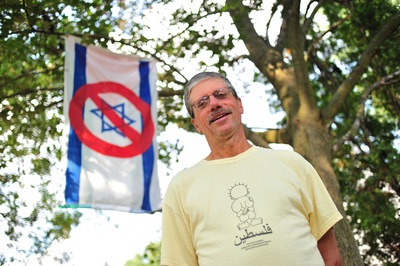
SF: "protesters ... wave doctored Israeli flags, with red lines crossing out the Star of David in the middle, and solicit honks from passing motorists."
Only one "doctored" Israeli flag has appeared at the protest outside the Beth Israel Congregation (BIC). On that flag, the red slash of the international no/prohibition symbol does indeed cross the "star of David", aka the "magen David", but solely because it is the central emblem adorning the flag of the State of Israel. That emblem, a hexagram, is not an ancient Judaic symbol.
As noted in the "Magen David" entry in the Encyclopaedia Judaica, the hexagram was used "as early as the Bronze Age ... in many civilizations and in regions as far apart as Mesopotamia and Britain." The symbol also "appears in early Byzantine and many medieval European churches ... Probably in imitation of church usage – and certainly not as a specifically Jewish symbol – the hexagram is found on some synagogues from the later Middle Ages ..."
So, how did the hexagram become associated with Jews and Judaism? According to the Encyclopaedia Judaica: "The prime motive behind the wide diffusion of the sign in the 19th century was the desire to imitate Christianity. ... From such general use it was taken over by the Zionist movement. The very first issue of Die Welt, Herzl's Zionist journal, bore it as its emblem."
Judaism 101 adds: "The Magen David gained popularity as a symbol of Judaism when it was adopted as the emblem of the Zionist movement in 1897, but the symbol continued to be controversial for many years afterward. When the modern state of Israel was founded, there was much debate over whether this symbol should be used on the flag."
SF: "the group—known as Jewish Witnesses For Peace and Friends even though Herskovitz is its only regular Jewish participant ..."
This false and misleading. Marcia Federbush, who is Jewish, also attends the vigil regularly. While it is true that a majority of current participants are not Jewish, this was not always the case. When the vigil started, Jews comprised a majority. Several Jews quit because they were not able to stand up to the pressure and smears meted out by Zionist Jews. Further, other Jews who were there from the beginning, such as Rachel Persico, Larry Hochman, and Sol Metz, have since died. It is, perhaps, a sign of the moral decrepitude of the larger Jewish community that no younger Jews have come forward to take their places.
SF: "Almost every Shabbat since Sept. 13, 2003, they have appeared at this corner on Washtenaw Avenue decrying the synagogue as an agent of Palestinian oppression."
This is also misleading. No one in JWPF asserts that BIC is "an agent of Palestinian oppression". As AnnArbor.com reported nearly a month ago: "Herskovitz said his group isn't blaming the synagogue for the actions of a foreign government — just holding the congregation accountable for supporting the state of Israel."
What is at issue is the synagogue's active and willful complicity in the oppression of Palestinians. This takes the form of its public expressions for the existence of a Jewish state in Palestine, the silencing of all but the most tepid of Jewish critics of the Jewish State, its trips to Israel to indoctrinate BIC youth into militant Zionism, and its cheer-leading when Israel goes to war. Not surprisingly, BIC leaders and members want to support Israel without experiencing the moral opprobrium that is their due.
SF: "But [Henry] Herskovitz's efforts are rooted in an old-fashioned intra-faith grudge: In 2003, the synagogue refused to let him present a slideshow of photographs he'd taken at a Palestinian refugee camp that he felt documented human rights abuses. Incensed, he turned to local pro-Palestinian groups for support."
To reduce Herskovitz's objections to being silenced by his synagogue, which had no problem hosting yoga classes on the sabbath, to an "old-fashioned intra-faith grudge" is a way of trivializing the issue. One can imagine a 17th century Steve Friess similarly characterizing Spinoza's expulsion from Amsterdam's Jewish community as an "old-fashioned intra-faith grudge".
Curious readers are invited to view the photos Herskovitz collected on his 2002 visit to the Balata refugee camp in the West Bank. His photos document the experience that began the transformation of a nominally Zionist Jew into a stalwart enemy of Jewish hypocrisy and chauvinism. Also, Herskovitz first turned to fellow Jews and the peace community from which he came when his efforts were rejected by Rabbi Dobrusin.
SF: "Beth Israel's rabbi, Robert Dobrusin, said he rejected the original request because he didn't know what context Herskovitz planned to use for his presentation. 'If what's happened since then is any indication, I was right,' Dobrusin said this week."
This is a rather strange assertion. Why didn't Dobrusin ask Herskovitz about the "context" and content? And why didn't Friess ask Dobrusin about that? In fact, I've spoken to Henry Herskovitz and he says Dobrusin knew exactly what he wanted to do.
SF: "Herskovitz, for his part, first called on Beth Israel to denounce Israel's existence, and now promises they'll stand down if Dobrusin removes the Israeli flag from the sanctuary."
Here is Herskovitz's comment on the Tablet Magazine web site:
SF:"[Herskovitz] says he attended High Holiday services at Beth Israel before Dobrusin's 1988 hire, but now he spends Yom Kippur each year taunting fasting worshippers by dubbing it International Eat-a-Cheeseburger Day."
Herskovitz never dubbed Yom Kippur anything and he certainly doesn't taunt anyone, no one brings burgers to the vigil. The only way "worshippers" would even know about the Bill Henry, Z"L, international Eat-a-Cheeseburger Day is if they chose to read about it here, in Herskovitz's weekly vigil reports, or, now, from Friess' article. Not much of a taunt.
SF: "[Herskovitz] and his group are scrupulous about staying off synagogue property and not obstructing anyone's ability to come and go—just as the synagogue has been scrupulous about respecting Herskovitz's First Amendment right to carry on protesting."
There is some truth to this. JWPF has been scrupulous about not obstructing people, the only people ever investigated or arrested by police in connection with the protests were a Beth Israel congregant, Eli Avny (Assault with a Deadly Weapon), and a BIC guest, Abraham Seligman (Assault and Battery). But there is a false equivalence suggested here. For, while JWPF has never sought any means, legal or extra-legal, to prevent people from attending services, the congregation has not been similarly respectful of the rights of JWPF members.
In 2007, it came to light that BIC was handing out a leaflet entitled,"Frequently Asked Questions About the Synagogue Protesters". It included these words:
SF: "But even many who are sympathetic to the plight of the Palestinians regard Herskovitz's group as an embarrassment. Imam Dawud Walid, executive director of the Council on American-Islamic Relations in Michigan, denounced the protest to The Arab American News, noting: "We'd be hypocrites to say it's not civil in front of mosques yet to endorse it taking place at other houses of worship ... There's a time and place for everything, and it would not be fitting for us as Muslims to protest in front of Jewish synagogues on the Sabbath day."
Interesting. Friess writes about "many" but, quoting a two-year-old article, he only cites a one person, Dawud Walid, a self-described "Black American Muslim" and a "revert to Islam" (read Walid's contribution in All-American: 45 American Men on Being Muslim). Here's something else attributed to him: "Dawud Walid ... said the root cause of the conflict [in Lebanon] was Israeli occupation of Lebanese, Palestinian and Syrian territory, not Islamic fundamentalist terrorists as the Bush Administration would prefer people to believe. He also told the cheering crowd that the interests of Israel are not the same as and should never supersede America's." (Source: Art Aisner, "Marchers protest war: Multiple speakers at rally highly critical of Israel", Ann Arbor News, August 12, 2006).
So, yes, if he still believe as he did seven years ago then Walid can probably fairly be said to be sympathetic to Palestinians so why does he object to the vigils? Not for Walid is the reasoning of Rabbi Abraham Heschel: "Worship preceded or followed by evil acts becomes an absurdity. The holy place is doomed when people indulge in unholy deeds." He is uninterested in what goes on in the synagogue or what it stands for.
It's simple, Walid doesn't want people protesting outside mosques. Here's what Herskovitz said about this in the same article Friess cites: "I would say that if a mosque was a Zionist mosque, as strange as that may sound, I would certainly not attack a group for protesting in front of such a mosque; we have protested in front of Zionist churches and synagogues before."
Perhaps, Walid's head-in-the-sand approach helps explain why he and an Episcopal bishop collaborated with Rabbi Dobrusin on an op-ed about torture. You see, a year before that op-ed was published Rabbi Dobrusin explained at a sabbath service how torture could be "justified" under Judaic law. Here's the key paragraph in Dobrusin's sermon:
SF: "Others point out that Dobrusin is a poor target, because the rabbi has been outspoken in his support for a two-state peace settlement. 'The rabbi is one of the most outspoken for addressing full equality for Arab citizens,' said Ann Arbor City Councilman Chuck Warpehoski, director of the local Interfaith Council, which has condemned Herskovitz and his followers. 'That's his dream for what Israel should be. We're talking about one of the people most willing to be critical of Israeli policy and he's the one who's targeted for this kind of abuse. It boggles the mind.' "
What truly "boggles the mind" is that any supposedly rational, ethical person could think that "support for a two-state peace settlement" is in any way about peace, justice, or "full equality." The South African apartheid regime, too, wanted separate states for Whites and Blacks but no decent, thinking person ever fell for that. By talking about "Arab citizens" Warpehoski also conveniently leaves 4.9 million Palestinian refugees of 1948 and 1967 out in the cold. Perhaps dollar signs are obscuring his moral vision, earlier this year the editor of A2Politico.com described Warpehoski as "a walking conflict of interest".
SF: "Herskovitz was happy to elaborate ... 'I said it's incumbent upon Jews to understand why they were hated and why they were treated so badly not only in Germany but other places,' he said. 'For one thing, the Bolsheviks from Russia were coming into Germany and Hitler feared the Bolsheviks, which were dominated by Jewish leadership. So he looked around and said, "Well, I have all these Jews in Germany." It's like the Japanese-Americans in World War Two, we didn't trust them so we rounded them up. That's what Hitler did.' Such commentary, while historically suspect and abhorrent to most Jews, has made Herskovitz a celebrity of the anti-Israel fringe."
Certainly, it is the burden of Jewish mainstream discourse to defend and propagate the notion of Jews as eternal innocents and their 'enemies' as irrational people who hate them only because of Jews' innate goodness, material success, godliness, or ________ (fill in the blank with a positive attribute of your choice). However, there are Jews (no one else can be trusted with such matters, right?) who lend credence to the idea that the rise of Nazism and the policies of the Third Reich were influenced by the behavior of Jews.
As Theodor Herzl explained in The Jewish State (1896):
Dennis Prager and Rabbi Joseph Telushkin, writing in Why the Jews?: The Reason for Antisemitism (2007), develop the idea that Jewish radicalism helps explain animosity toward Jews. In fact, they have a whole chapter on the subject where they state flatly: "During the last century some of these Jews have contributed to intense Jew-hatred. These are radical and revolutionary Jews" (p. 42). They assert, "The association of Jews with revolutionary doctrines and social upheaval has not, unfortunately, been the product of antisemites' imaginations" (p. 43). They take note of "the highly disproportionate role played by Jews in radical causes ..." (p. 43) explaining that "radical alienated Jews have been active in societies as diverse as despotic and antisemitic czarist Russia, the democratic Weimar Germany, and the United States" (pp. 44-45).
They remind readers, for example, that "Béla Kun, a Jew, established the short-lived Hungarian Soviet Republic in March of [1919]. Of the 48 people's commissars in his government, 30 were Jews as were 161 of its 202 highest officials" (p. 46)."In Germany," they write, "until 1933 when Hitler came to power, the predominance of Jews on the radical left was as pronounced as in Russia. ... These Jewish radicals wielded a major influence over the cultural and intellectual life of Weimar Germany, an influence utterly disproportionate to their numbers ... " and "to many Germans ... they stood out as destroyers of everything German" ( p. 46).
In The Fatal Embrace: Jews and the State (1993), Benjamin Ginsberg argues "Jews played key roles in constructing a number of the most important states to emerge ... over the past 700 years. ... For many of these states, Jews were crucial in building and staffing institutions of extraction, coercion, administration, and mobilization ... these relationships have been the chief catalysts for organized anti-Semitism" (p. 11). Of Soviet Russia and the USSR, he says: "the special contribution of the Jews to the Bolshevik state involved the organization of coercion. From the beginning, the Soviet state relied heavily upon military, police, and security services to sustain itself, and Jews were active in these agencies. ... Jews had traditionally been at the margins of Russian society and, hence, prepared to staff and direct the coercive instruments upon which the state relied to control its citizens" (pp. 30-31).
Ginsberg also goes into some detail about how Jews were central to the creation of the Weimar Republic and dominated German economic, political, and cultural life during the inter-war period. And Ginsberg cites Rosa Luxemburg, a Jewish communist, as "one of the most prominent leaders" of the failed German Revolution of 1918–19, and mentions three other Jews prominent in the communist coup d'etat in Bavaria that resulted in the short-lived Bavarian Soviet Republic in 1919: Eugen Leviné, Gustav Landauer, and Ernst Toller (p. 29).
From Samuel Landman, in Great Britain, the Jews and Palestine (1936) and echoing British PM Lloyd George, we learn that American Zionist Jews were mobilized on a "quid pro quo contract basis" to bring the US into World War I on the side of Britain and France (p. 4). The payoff was the Balfour Declaration. Landman was a British Jewish Zionist insider and he claims: "The fact that it was Jewish help that brought U.S.A. into the War on the side of the Allies has rankled ever since in German—especially Nazi—minds, and has contributed in no small measure to the prominence which anti-Semitism occupies in the Nazi programme" (p. 6).
Regarding Bolshevik Russia, Winston Churchill averred in 1920: "There is no need to exaggerate the part played in the creation of Bolshevism and in the actual bringing about of the Russian Revolution, by these international and for the most part atheistical Jews, it is certainly a very great one; it probably outweighs all others. With the notable exception of Lenin [in fact, Lenin, too, had Jewish ancestry] the majority of the leading figures are Jews. Moreover, the principal inspiration and driving power comes from the Jewish leaders." Of course, since Churchill is not Jewish he cannot be regarded as a reliable source in this matter.
Now, let's sum up what we have learned in this final section. Contra Friess, there is nothing "suspect" about Herskovitz's "commentary" about attempting to understand the rational basis for German antipathy to Jews. This is not to excuse the irrational imputation of collective guilt to all Jews qua Jews but to point out that there is evidence that Jews, a tiny minority, exercised disproportionate power in Russia, Germany, and elsewhere. Jews used power in their perceived self-interest and in a manner which alienated and angered members of the majority populations of these countries. Jews may find this truth "abhorrent" but they do no one, least of all themselves, any favors by refusing to wrestle with it.
Finally, Friess claims that Herskovitz's "commentary" has made him "a celebrity of the anti-Israel fringe." My last question to Friess is what fringe? There is reason to believe that the pro-Israel crowd may be the true fringe. According to an international scientific poll commissioned by the BBC this year, only 21% of respondents thought Israel had a "mainly positive" influence in the world. 52% thought Israel had a "mainly negative" influence, putting the country in the same class with North Korea.
SF: "protesters ... wave doctored Israeli flags, with red lines crossing out the Star of David in the middle, and solicit honks from passing motorists."
Only one "doctored" Israeli flag has appeared at the protest outside the Beth Israel Congregation (BIC). On that flag, the red slash of the international no/prohibition symbol does indeed cross the "star of David", aka the "magen David", but solely because it is the central emblem adorning the flag of the State of Israel. That emblem, a hexagram, is not an ancient Judaic symbol.
As noted in the "Magen David" entry in the Encyclopaedia Judaica, the hexagram was used "as early as the Bronze Age ... in many civilizations and in regions as far apart as Mesopotamia and Britain." The symbol also "appears in early Byzantine and many medieval European churches ... Probably in imitation of church usage – and certainly not as a specifically Jewish symbol – the hexagram is found on some synagogues from the later Middle Ages ..."
So, how did the hexagram become associated with Jews and Judaism? According to the Encyclopaedia Judaica: "The prime motive behind the wide diffusion of the sign in the 19th century was the desire to imitate Christianity. ... From such general use it was taken over by the Zionist movement. The very first issue of Die Welt, Herzl's Zionist journal, bore it as its emblem."
Judaism 101 adds: "The Magen David gained popularity as a symbol of Judaism when it was adopted as the emblem of the Zionist movement in 1897, but the symbol continued to be controversial for many years afterward. When the modern state of Israel was founded, there was much debate over whether this symbol should be used on the flag."
SF: "the group—known as Jewish Witnesses For Peace and Friends even though Herskovitz is its only regular Jewish participant ..."
This false and misleading. Marcia Federbush, who is Jewish, also attends the vigil regularly. While it is true that a majority of current participants are not Jewish, this was not always the case. When the vigil started, Jews comprised a majority. Several Jews quit because they were not able to stand up to the pressure and smears meted out by Zionist Jews. Further, other Jews who were there from the beginning, such as Rachel Persico, Larry Hochman, and Sol Metz, have since died. It is, perhaps, a sign of the moral decrepitude of the larger Jewish community that no younger Jews have come forward to take their places.
SF: "Almost every Shabbat since Sept. 13, 2003, they have appeared at this corner on Washtenaw Avenue decrying the synagogue as an agent of Palestinian oppression."
This is also misleading. No one in JWPF asserts that BIC is "an agent of Palestinian oppression". As AnnArbor.com reported nearly a month ago: "Herskovitz said his group isn't blaming the synagogue for the actions of a foreign government — just holding the congregation accountable for supporting the state of Israel."
What is at issue is the synagogue's active and willful complicity in the oppression of Palestinians. This takes the form of its public expressions for the existence of a Jewish state in Palestine, the silencing of all but the most tepid of Jewish critics of the Jewish State, its trips to Israel to indoctrinate BIC youth into militant Zionism, and its cheer-leading when Israel goes to war. Not surprisingly, BIC leaders and members want to support Israel without experiencing the moral opprobrium that is their due.
SF: "But [Henry] Herskovitz's efforts are rooted in an old-fashioned intra-faith grudge: In 2003, the synagogue refused to let him present a slideshow of photographs he'd taken at a Palestinian refugee camp that he felt documented human rights abuses. Incensed, he turned to local pro-Palestinian groups for support."
To reduce Herskovitz's objections to being silenced by his synagogue, which had no problem hosting yoga classes on the sabbath, to an "old-fashioned intra-faith grudge" is a way of trivializing the issue. One can imagine a 17th century Steve Friess similarly characterizing Spinoza's expulsion from Amsterdam's Jewish community as an "old-fashioned intra-faith grudge".
Curious readers are invited to view the photos Herskovitz collected on his 2002 visit to the Balata refugee camp in the West Bank. His photos document the experience that began the transformation of a nominally Zionist Jew into a stalwart enemy of Jewish hypocrisy and chauvinism. Also, Herskovitz first turned to fellow Jews and the peace community from which he came when his efforts were rejected by Rabbi Dobrusin.
SF: "Beth Israel's rabbi, Robert Dobrusin, said he rejected the original request because he didn't know what context Herskovitz planned to use for his presentation. 'If what's happened since then is any indication, I was right,' Dobrusin said this week."
This is a rather strange assertion. Why didn't Dobrusin ask Herskovitz about the "context" and content? And why didn't Friess ask Dobrusin about that? In fact, I've spoken to Henry Herskovitz and he says Dobrusin knew exactly what he wanted to do.
SF: "Herskovitz, for his part, first called on Beth Israel to denounce Israel's existence, and now promises they'll stand down if Dobrusin removes the Israeli flag from the sanctuary."
Here is Herskovitz's comment on the Tablet Magazine web site:
Friess' claim that "Herskovitz, for his part, first called on Beth Israel to denounce Israel’s existence" is simply not true. Though I personally believe that Israel has no right to exist as a Jewish supremacist state, I have never called upon Beth Israel to do the same, whether it was when the vigils started, nor now.It is also inaccurate to report that removing the flag will end the vigils. That is Herskovitz's personal issue, JWPF has never adopted that position collectively.
Rather, as our deceased friend and vigiler Sol Metz reiterated in the Ann Arbor News (July 17, 2009): "Jewish Witnesses for Peace and Friends will end the vigils if Beth Israel satisfies our three previously stated requests or if equivalent goals are achieved through negotiations with Beth Israel: Committing to work for the equal rights for the Palestinian citizens of Israel, committing to work for the end of the occupation of the West Bank, Gaza, and East Jerusalem, and committing to work for the right of Palestinians to return to the homes from which they were forcibly removed in what was to become Israel."
SF:"[Herskovitz] says he attended High Holiday services at Beth Israel before Dobrusin's 1988 hire, but now he spends Yom Kippur each year taunting fasting worshippers by dubbing it International Eat-a-Cheeseburger Day."
Herskovitz never dubbed Yom Kippur anything and he certainly doesn't taunt anyone, no one brings burgers to the vigil. The only way "worshippers" would even know about the Bill Henry, Z"L, international Eat-a-Cheeseburger Day is if they chose to read about it here, in Herskovitz's weekly vigil reports, or, now, from Friess' article. Not much of a taunt.
SF: "[Herskovitz] and his group are scrupulous about staying off synagogue property and not obstructing anyone's ability to come and go—just as the synagogue has been scrupulous about respecting Herskovitz's First Amendment right to carry on protesting."
There is some truth to this. JWPF has been scrupulous about not obstructing people, the only people ever investigated or arrested by police in connection with the protests were a Beth Israel congregant, Eli Avny (Assault with a Deadly Weapon), and a BIC guest, Abraham Seligman (Assault and Battery). But there is a false equivalence suggested here. For, while JWPF has never sought any means, legal or extra-legal, to prevent people from attending services, the congregation has not been similarly respectful of the rights of JWPF members.
In 2007, it came to light that BIC was handing out a leaflet entitled,"Frequently Asked Questions About the Synagogue Protesters". It included these words:
Since what they are doing is legal, we cannot force them to leave, and we do not want to hand them the publicity a legal fight would entail. Our instincts in this area have been affirmed by the current and former Ann Arbor police chiefs, and by numerous other attorneys and community leaders we gave consulted. We continue to investigate legal options, albeit without much optimism.It is clear that the leaders of BIC acknowledge the free speech rights of JWPF only grudgingly and, at least at that time, they continued look for the means to silence them.
SF: "But even many who are sympathetic to the plight of the Palestinians regard Herskovitz's group as an embarrassment. Imam Dawud Walid, executive director of the Council on American-Islamic Relations in Michigan, denounced the protest to The Arab American News, noting: "We'd be hypocrites to say it's not civil in front of mosques yet to endorse it taking place at other houses of worship ... There's a time and place for everything, and it would not be fitting for us as Muslims to protest in front of Jewish synagogues on the Sabbath day."
Interesting. Friess writes about "many" but, quoting a two-year-old article, he only cites a one person, Dawud Walid, a self-described "Black American Muslim" and a "revert to Islam" (read Walid's contribution in All-American: 45 American Men on Being Muslim). Here's something else attributed to him: "Dawud Walid ... said the root cause of the conflict [in Lebanon] was Israeli occupation of Lebanese, Palestinian and Syrian territory, not Islamic fundamentalist terrorists as the Bush Administration would prefer people to believe. He also told the cheering crowd that the interests of Israel are not the same as and should never supersede America's." (Source: Art Aisner, "Marchers protest war: Multiple speakers at rally highly critical of Israel", Ann Arbor News, August 12, 2006).
So, yes, if he still believe as he did seven years ago then Walid can probably fairly be said to be sympathetic to Palestinians so why does he object to the vigils? Not for Walid is the reasoning of Rabbi Abraham Heschel: "Worship preceded or followed by evil acts becomes an absurdity. The holy place is doomed when people indulge in unholy deeds." He is uninterested in what goes on in the synagogue or what it stands for.
It's simple, Walid doesn't want people protesting outside mosques. Here's what Herskovitz said about this in the same article Friess cites: "I would say that if a mosque was a Zionist mosque, as strange as that may sound, I would certainly not attack a group for protesting in front of such a mosque; we have protested in front of Zionist churches and synagogues before."
Perhaps, Walid's head-in-the-sand approach helps explain why he and an Episcopal bishop collaborated with Rabbi Dobrusin on an op-ed about torture. You see, a year before that op-ed was published Rabbi Dobrusin explained at a sabbath service how torture could be "justified" under Judaic law. Here's the key paragraph in Dobrusin's sermon:
Some might ask: Doesn't making torture illegal tie the hands of our military in the event that an act of torture might possibly save thousands of Americans? Think about how we would respond if, God forbid, our family members were in danger. We would do what we thought we had to do, and then would seek to defend ourselves as having committed a justified act of self-defense. But we don't go into situations saying that morals don't matter in how we live our lives.Yes, opposition to torture matters--all the way up to the point that it doesn't. When the situation gets challenging then "We would do what we thought we had to do ..."
SF: "Others point out that Dobrusin is a poor target, because the rabbi has been outspoken in his support for a two-state peace settlement. 'The rabbi is one of the most outspoken for addressing full equality for Arab citizens,' said Ann Arbor City Councilman Chuck Warpehoski, director of the local Interfaith Council, which has condemned Herskovitz and his followers. 'That's his dream for what Israel should be. We're talking about one of the people most willing to be critical of Israeli policy and he's the one who's targeted for this kind of abuse. It boggles the mind.' "
What truly "boggles the mind" is that any supposedly rational, ethical person could think that "support for a two-state peace settlement" is in any way about peace, justice, or "full equality." The South African apartheid regime, too, wanted separate states for Whites and Blacks but no decent, thinking person ever fell for that. By talking about "Arab citizens" Warpehoski also conveniently leaves 4.9 million Palestinian refugees of 1948 and 1967 out in the cold. Perhaps dollar signs are obscuring his moral vision, earlier this year the editor of A2Politico.com described Warpehoski as "a walking conflict of interest".
SF: "Herskovitz was happy to elaborate ... 'I said it's incumbent upon Jews to understand why they were hated and why they were treated so badly not only in Germany but other places,' he said. 'For one thing, the Bolsheviks from Russia were coming into Germany and Hitler feared the Bolsheviks, which were dominated by Jewish leadership. So he looked around and said, "Well, I have all these Jews in Germany." It's like the Japanese-Americans in World War Two, we didn't trust them so we rounded them up. That's what Hitler did.' Such commentary, while historically suspect and abhorrent to most Jews, has made Herskovitz a celebrity of the anti-Israel fringe."
Certainly, it is the burden of Jewish mainstream discourse to defend and propagate the notion of Jews as eternal innocents and their 'enemies' as irrational people who hate them only because of Jews' innate goodness, material success, godliness, or ________ (fill in the blank with a positive attribute of your choice). However, there are Jews (no one else can be trusted with such matters, right?) who lend credence to the idea that the rise of Nazism and the policies of the Third Reich were influenced by the behavior of Jews.
As Theodor Herzl explained in The Jewish State (1896):
... Governments will never take action against all Jews. The equal rights of the Jew before the law cannot be withdrawn where they have once been conceded; for the first attempt at withdrawal would immediately drive all Jews, rich and poor alike, into the ranks of revolutionary parties. The beginning of any official acts of injustice against the Jews invariably brings about economic crises. Therefore, no weapons can be effectively used against us, because these injure the hands that wield them. Meantime hatred grows apace.Although Herzl was clearly mistaken in failing to anticipate the Third Reich his main point is well-taken and Nazi Germany is an exception that proves the rule. Jews did use their power to create an economic crisis in Germany and their efforts to topple Hitler may well have succeeded if they hadn't been halted by Jews.
Dennis Prager and Rabbi Joseph Telushkin, writing in Why the Jews?: The Reason for Antisemitism (2007), develop the idea that Jewish radicalism helps explain animosity toward Jews. In fact, they have a whole chapter on the subject where they state flatly: "During the last century some of these Jews have contributed to intense Jew-hatred. These are radical and revolutionary Jews" (p. 42). They assert, "The association of Jews with revolutionary doctrines and social upheaval has not, unfortunately, been the product of antisemites' imaginations" (p. 43). They take note of "the highly disproportionate role played by Jews in radical causes ..." (p. 43) explaining that "radical alienated Jews have been active in societies as diverse as despotic and antisemitic czarist Russia, the democratic Weimar Germany, and the United States" (pp. 44-45).
They remind readers, for example, that "Béla Kun, a Jew, established the short-lived Hungarian Soviet Republic in March of [1919]. Of the 48 people's commissars in his government, 30 were Jews as were 161 of its 202 highest officials" (p. 46)."In Germany," they write, "until 1933 when Hitler came to power, the predominance of Jews on the radical left was as pronounced as in Russia. ... These Jewish radicals wielded a major influence over the cultural and intellectual life of Weimar Germany, an influence utterly disproportionate to their numbers ... " and "to many Germans ... they stood out as destroyers of everything German" ( p. 46).
In The Fatal Embrace: Jews and the State (1993), Benjamin Ginsberg argues "Jews played key roles in constructing a number of the most important states to emerge ... over the past 700 years. ... For many of these states, Jews were crucial in building and staffing institutions of extraction, coercion, administration, and mobilization ... these relationships have been the chief catalysts for organized anti-Semitism" (p. 11). Of Soviet Russia and the USSR, he says: "the special contribution of the Jews to the Bolshevik state involved the organization of coercion. From the beginning, the Soviet state relied heavily upon military, police, and security services to sustain itself, and Jews were active in these agencies. ... Jews had traditionally been at the margins of Russian society and, hence, prepared to staff and direct the coercive instruments upon which the state relied to control its citizens" (pp. 30-31).
Ginsberg also goes into some detail about how Jews were central to the creation of the Weimar Republic and dominated German economic, political, and cultural life during the inter-war period. And Ginsberg cites Rosa Luxemburg, a Jewish communist, as "one of the most prominent leaders" of the failed German Revolution of 1918–19, and mentions three other Jews prominent in the communist coup d'etat in Bavaria that resulted in the short-lived Bavarian Soviet Republic in 1919: Eugen Leviné, Gustav Landauer, and Ernst Toller (p. 29).
From Samuel Landman, in Great Britain, the Jews and Palestine (1936) and echoing British PM Lloyd George, we learn that American Zionist Jews were mobilized on a "quid pro quo contract basis" to bring the US into World War I on the side of Britain and France (p. 4). The payoff was the Balfour Declaration. Landman was a British Jewish Zionist insider and he claims: "The fact that it was Jewish help that brought U.S.A. into the War on the side of the Allies has rankled ever since in German—especially Nazi—minds, and has contributed in no small measure to the prominence which anti-Semitism occupies in the Nazi programme" (p. 6).
Regarding Bolshevik Russia, Winston Churchill averred in 1920: "There is no need to exaggerate the part played in the creation of Bolshevism and in the actual bringing about of the Russian Revolution, by these international and for the most part atheistical Jews, it is certainly a very great one; it probably outweighs all others. With the notable exception of Lenin [in fact, Lenin, too, had Jewish ancestry] the majority of the leading figures are Jews. Moreover, the principal inspiration and driving power comes from the Jewish leaders." Of course, since Churchill is not Jewish he cannot be regarded as a reliable source in this matter.
Now, let's sum up what we have learned in this final section. Contra Friess, there is nothing "suspect" about Herskovitz's "commentary" about attempting to understand the rational basis for German antipathy to Jews. This is not to excuse the irrational imputation of collective guilt to all Jews qua Jews but to point out that there is evidence that Jews, a tiny minority, exercised disproportionate power in Russia, Germany, and elsewhere. Jews used power in their perceived self-interest and in a manner which alienated and angered members of the majority populations of these countries. Jews may find this truth "abhorrent" but they do no one, least of all themselves, any favors by refusing to wrestle with it.
Finally, Friess claims that Herskovitz's "commentary" has made him "a celebrity of the anti-Israel fringe." My last question to Friess is what fringe? There is reason to believe that the pro-Israel crowd may be the true fringe. According to an international scientific poll commissioned by the BBC this year, only 21% of respondents thought Israel had a "mainly positive" influence in the world. 52% thought Israel had a "mainly negative" influence, putting the country in the same class with North Korea.
Labels: Benedict Spinoza, Beth Israel, Henry Herskovitz, history, Israel, Jewish Witnesses for Peace and Friends, Jews, Warpehoski
// posted by PeaceMonger @ 9/24/2013 07:31:00 PM 0 comments


Social Bookmarking Tools:


Comments Policy
Social Bookmarking Tools:
Comments Policy
Saturday, February 27, 2010
Will IJAN Challenge Jewish Power?
Below is the analysis of Henry Herskovitz (with Michelle J. Kinnucan) of Jewish Witnesses for Peace and Friends to a recent op-ed by Rebecca Tumposky on the International Jewish Anti-Zionist Network (IJAN).
There are many problems with IJAN, which lead me to doubt the purposes of the group. I first question whether they are a Palestinian solidarity group or yet another group that seeks to shield and preserve Jewish power both in Palestine and in the U.S.
In this writer's opinion, Jews - if they are acting in a group that represents Jews in the peace movement - should first and foremost challenge what Akiva Eldar and J. J. Goldberg, among others, call the "Jewish lobby" - the powerful people and institutions (and their rank-and-file supporters) who dominate the US discourse and policy regarding Jews and Israel. Often, these are the very people behind the charge of "self-hating Jews" (and for non-Jews, "anti-Semites") about whom Rebecca Tumposky, national organizer with the International Jewish Anti-Zionist Network, complains. Yet, nowhere in her article does Ms. Tumposky show a disposition to directly do that.
It is perhaps worth mentioning that three originators of IJAN who live in southeast Michigan, including "Invincible," declined the invitation to stand vigil with us at our Global Vigil Day in 2007 or at any other time. They refused to expose and challenge Beth Israel Congregation--a local institutional bastion of open, unabashed Jewish support for Israel--when they had the opportunity. And yes, I'm the first to admit that standing in front of a synagogue is not the only way to challenge Jewish power, but at the same time ask where does IJAN directly challenge this power using another tactic?
In Tumposky's op-ed she says IJAN "seeks to challenge the violence and injustice of Israeli apartheid" but she and IJAN are US-based. So, where is her mention, let alone challenge, of the Jewish supremacism/power that allows Jews - less than two percent of the US population - to so effectively steer US policy and resources into underwriting Jewish apartheid in Palestine?
Right out of the box, she shows her hand - Tumposky's and IJAN's opposition to apartheid is rooted not in universalistic notions of justice and human rights but in Jewish chauvinism/exceptionalism. Thus, they appeal to Jews on the grounds of "our varied traditions of social justice." And Tumposky wants to make sure - absolutely certain - that fighting anti-Semitism is prioritized in any work on freeing Palestine from the genocide brought on by the Jewish state. Thus, she writes, "We challenge anti-Jewish prejudice while standing in solidarity with organizations that support Palestinian liberation and historic justice ..." In short, IJAN enters the Palestinian solidarity movement with an explicit agenda of highlighting, if not foregrounding, the concerns of Jews, the very people who enjoy Jewish privilege here and in Israel.
Her opposition to Zionism is carefully couched as a subset of opposing colonialism and imperialism, in general: "We share a commitment to participation in struggles against colonialism and imperialism. We therefore oppose Zionism ... IJAN, in fact, opposes all imperialist aggression". She refuses to take notice of the peculiar situation of Zionism - Jewish imperialism - in that Jews lacked a nation-state of their own and, thus, Zionists commandeered other countries, namely Britain and the US, to realize their goals.
Tumposky beats up one or two carefully placed straw men along the way: "We will say it again and again, despite accusations of being 'self-hating Jews': Zionism is not Judaism and the Jewish community." Just who is it that equates Zionism with "Judaism and the Jewish community"? And why is this point so essential for "anti-Zionists" like the IJAN folks? What would Tumposky say to the 757 rabbis - "the largest number of rabbis whose signatures are attached to a public pronouncement in all Jewish history" - who in 1942 stated that Zionism is an "Affirmation of Judaism" and "Anti-Zionism, not Zionism, is a departure from the Jewish religion"?
She also plays a Left Zionist game when she attempts to distinguish the 'types' of Zionism, claiming that "the Zionism we oppose is not a longstanding cultural or religious expression". She conveniently ignores the fact that when push came to shove, all the Zionists - Left, Right and Center - gave their blessings to destroying Palestine.
In the first chapter of his book Image and Reality of the Israel-Palestine Conflict, Norman Finkelstein challenged the myth that any of the Zionist tendencies (Labor, Religious, etc.) were ever benign. In short, the only thing about Zionism that really matters is that it "is a form of racism and racial discrimination," as the UN General Assembly correctly identified in 1975.
Tumposky's definition of Zionism is also problematic - "the 19th century ideology that led European Jews to work with imperialist powers to displace and ethnically cleanse the Palestinian people, which continues today." It is folly to imply that Jews were passive objects of that "ideology". Zionism was created, implemented, and popularized by Jews. Are readers supposed to believe that it was the imperialist powers that Jews only "worked with" that committed this crime? Isn't it more accurate to say that Jews led these imperialist powers by the nose - as they still do today - to have non-Jews die for the Jewish state?
When she writes "Israel and its U.S. lobby helped pushed us toward the Iraq war and are exerting similar pressure to attack Iran", readers need to be cognizant of what she omits - EVERY major constituent group of the organized Jewish community pressed for war on Iraq, and there's a list of at least two dozen Jewish individuals - in powerful government or media positions - who also pressed strongly for war.
Tumposky touts "Jewish visions of collective liberation and traditions of social justice", but doesn't give us any proof that this tradition ever existed, other than in the minds of Jews who want their image spit-shined, if not outright falsified. More than 300 years ago, Benedictus de Spinoza, who is often upheld as a great Jewish intellectual, observed that Jews had in fact nothing to commend themselves as superior to others, had acted in such a way as to "incur the hatred of all", and that this hatred was the glue that bound Jews together. Other than, perhaps, a few years during the Civil Rights struggle (and Benjamin Ginsberg casts doubt on even this), Jews collectively have acted in concert NOT for universal well-being, but for the benefit of Jews. IJAN does not seem to be an exception.
Distinguishing IJAN from AIPAC, J-Street and Tikkun, might make good reading, but doesn't let them off the hook. Once again, I'm reminded of Paul Eisen's words: "The crime against the Palestinian people is being committed by a Jewish state with Jewish soldiers using weapons displaying Jewish religious symbols, and with the full support and complicity of the overwhelming mass of organized Jews worldwide. But to name Jews as responsible for this crime seems impossible to do." It seems obvious to me that IJAN and similar organizations exist, in no small part, to prevent the naming of Jews as responsible for the Jewish-led genocide against the Palestinian people.
There are many problems with IJAN, which lead me to doubt the purposes of the group. I first question whether they are a Palestinian solidarity group or yet another group that seeks to shield and preserve Jewish power both in Palestine and in the U.S.
In this writer's opinion, Jews - if they are acting in a group that represents Jews in the peace movement - should first and foremost challenge what Akiva Eldar and J. J. Goldberg, among others, call the "Jewish lobby" - the powerful people and institutions (and their rank-and-file supporters) who dominate the US discourse and policy regarding Jews and Israel. Often, these are the very people behind the charge of "self-hating Jews" (and for non-Jews, "anti-Semites") about whom Rebecca Tumposky, national organizer with the International Jewish Anti-Zionist Network, complains. Yet, nowhere in her article does Ms. Tumposky show a disposition to directly do that.
It is perhaps worth mentioning that three originators of IJAN who live in southeast Michigan, including "Invincible," declined the invitation to stand vigil with us at our Global Vigil Day in 2007 or at any other time. They refused to expose and challenge Beth Israel Congregation--a local institutional bastion of open, unabashed Jewish support for Israel--when they had the opportunity. And yes, I'm the first to admit that standing in front of a synagogue is not the only way to challenge Jewish power, but at the same time ask where does IJAN directly challenge this power using another tactic?
In Tumposky's op-ed she says IJAN "seeks to challenge the violence and injustice of Israeli apartheid" but she and IJAN are US-based. So, where is her mention, let alone challenge, of the Jewish supremacism/power that allows Jews - less than two percent of the US population - to so effectively steer US policy and resources into underwriting Jewish apartheid in Palestine?
Right out of the box, she shows her hand - Tumposky's and IJAN's opposition to apartheid is rooted not in universalistic notions of justice and human rights but in Jewish chauvinism/exceptionalism. Thus, they appeal to Jews on the grounds of "our varied traditions of social justice." And Tumposky wants to make sure - absolutely certain - that fighting anti-Semitism is prioritized in any work on freeing Palestine from the genocide brought on by the Jewish state. Thus, she writes, "We challenge anti-Jewish prejudice while standing in solidarity with organizations that support Palestinian liberation and historic justice ..." In short, IJAN enters the Palestinian solidarity movement with an explicit agenda of highlighting, if not foregrounding, the concerns of Jews, the very people who enjoy Jewish privilege here and in Israel.
Her opposition to Zionism is carefully couched as a subset of opposing colonialism and imperialism, in general: "We share a commitment to participation in struggles against colonialism and imperialism. We therefore oppose Zionism ... IJAN, in fact, opposes all imperialist aggression". She refuses to take notice of the peculiar situation of Zionism - Jewish imperialism - in that Jews lacked a nation-state of their own and, thus, Zionists commandeered other countries, namely Britain and the US, to realize their goals.
Tumposky beats up one or two carefully placed straw men along the way: "We will say it again and again, despite accusations of being 'self-hating Jews': Zionism is not Judaism and the Jewish community." Just who is it that equates Zionism with "Judaism and the Jewish community"? And why is this point so essential for "anti-Zionists" like the IJAN folks? What would Tumposky say to the 757 rabbis - "the largest number of rabbis whose signatures are attached to a public pronouncement in all Jewish history" - who in 1942 stated that Zionism is an "Affirmation of Judaism" and "Anti-Zionism, not Zionism, is a departure from the Jewish religion"?
She also plays a Left Zionist game when she attempts to distinguish the 'types' of Zionism, claiming that "the Zionism we oppose is not a longstanding cultural or religious expression". She conveniently ignores the fact that when push came to shove, all the Zionists - Left, Right and Center - gave their blessings to destroying Palestine.
In the first chapter of his book Image and Reality of the Israel-Palestine Conflict, Norman Finkelstein challenged the myth that any of the Zionist tendencies (Labor, Religious, etc.) were ever benign. In short, the only thing about Zionism that really matters is that it "is a form of racism and racial discrimination," as the UN General Assembly correctly identified in 1975.
Tumposky's definition of Zionism is also problematic - "the 19th century ideology that led European Jews to work with imperialist powers to displace and ethnically cleanse the Palestinian people, which continues today." It is folly to imply that Jews were passive objects of that "ideology". Zionism was created, implemented, and popularized by Jews. Are readers supposed to believe that it was the imperialist powers that Jews only "worked with" that committed this crime? Isn't it more accurate to say that Jews led these imperialist powers by the nose - as they still do today - to have non-Jews die for the Jewish state?
When she writes "Israel and its U.S. lobby helped pushed us toward the Iraq war and are exerting similar pressure to attack Iran", readers need to be cognizant of what she omits - EVERY major constituent group of the organized Jewish community pressed for war on Iraq, and there's a list of at least two dozen Jewish individuals - in powerful government or media positions - who also pressed strongly for war.
Tumposky touts "Jewish visions of collective liberation and traditions of social justice", but doesn't give us any proof that this tradition ever existed, other than in the minds of Jews who want their image spit-shined, if not outright falsified. More than 300 years ago, Benedictus de Spinoza, who is often upheld as a great Jewish intellectual, observed that Jews had in fact nothing to commend themselves as superior to others, had acted in such a way as to "incur the hatred of all", and that this hatred was the glue that bound Jews together. Other than, perhaps, a few years during the Civil Rights struggle (and Benjamin Ginsberg casts doubt on even this), Jews collectively have acted in concert NOT for universal well-being, but for the benefit of Jews. IJAN does not seem to be an exception.
Distinguishing IJAN from AIPAC, J-Street and Tikkun, might make good reading, but doesn't let them off the hook. Once again, I'm reminded of Paul Eisen's words: "The crime against the Palestinian people is being committed by a Jewish state with Jewish soldiers using weapons displaying Jewish religious symbols, and with the full support and complicity of the overwhelming mass of organized Jews worldwide. But to name Jews as responsible for this crime seems impossible to do." It seems obvious to me that IJAN and similar organizations exist, in no small part, to prevent the naming of Jews as responsible for the Jewish-led genocide against the Palestinian people.
Labels: anti-Zionism, Benedict Spinoza, Henry Herskovitz, Israel, Jewish Witnesses for Peace and Friends, Norman G. Finkelstein
// posted by PeaceMonger @ 2/27/2010 03:16:00 PM 0 comments
Social Bookmarking Tools:
Comments Policy
Social Bookmarking Tools:
Comments Policy
Sunday, January 04, 2009
Readers Respond to "Israel's Hanukkah Massacre & Judaism's Culture of Death"
All of the reader responses to Israel's Hanukkah Massacre & Judaism's Culture of Death discussed below came to me by e-mail.
Here's the first one I got from a Muslim friend:
Here's the first one I got from a Muslim friend:
I'm emailing you from Arizona. Weather is perfect over here.Here's the response I sent a couple of days ago:
I don't know enough about Jewish law and Israel's history to know about this, but is it possible that Israel is to Jewish law what Saudi Arabia, for example, is to Islam? So Saudi Arabia gives a bad image of Islam by misinterpreting Sharia and prohibiting women from driving etc. There is no shortage of Muslims who misapply Sharia law i.e. Al-Qaeda types who take a verse from the Quran to mean that Muslims should kill "infidels" wherever they find them. And Taliban types who find in Islam a justification for prohibiting girls from attending school. Or Christians who find justification in the Bible for attacking abortion clinics or burning witches at the stake. You know what I mean. The examples are countless.
As the Neturei Karta would argue, Zionism and Judaism are polar opposites, so is it also possible that Israel misapplies halacha and that "authentic" Judaism is innocent from Zionism's crimes?
It's about 25 degrees here--happy? ;-)A less friendly response appears next:
As to your question, to an important extent I think religion is as religion does and religion says. So, I don't think I can tell anyone what "authentic" Judaism is nor can the Saudi family tell us what "authentic" Islam is nor can the Neturei Karta tell us what "authentic" Judaism is. Ditto for Christianity. What I think we have to do is consider what is actually being done by the adherents of those religions. Thus, when I have written about Judaism I never insist that I am writing about "authentic" Judaism. I may quote someone else who makes that claim but it is up to the reader to evaluate such claims.
To get more concrete, let's look at Zionism and Judaism. As you have noted, Neturei Karta would argue they "are polar opposites" but the evidence suggests that the vast majority of adherents of Judaism disagree. The main bodies of Orthodox, Conservative, and Reform Judaism have all explicitly endorsed Zionism in practice, if not in name, that is they all support Israel as a Jewish state in Palestine. The same is true of the smaller Reconstructionist and Secular Humanist movements. But it is not for me to say whether or not that represents "authentic" Judaism.
You ask, "is it ... possible that 'authentic' Judaism is innocent from Zionism's crimes." My short answer is yes but what is "authentic" Judaism? Who gets to decide? What are the consequences of absolving/obscuring Judaism as it is actually practiced here and now by most of its adherents because some small minority insists that Zionist Judaism or Judaic Zionism are not "authentic"? As Paul Eisen writes:
The present, too, is full of ambiguities. Zionism is not Judaism; Judaism is not Zionism has become an article of faith, endlessly repeated, as is the assertion that Zionism is a secular ideology opposed, for much of its history, by the bulk of religious Jews and even now still opposed by true Torah Jews such as Neturei Karta. But Zionism is now at the heart of Jewish life with religious Jews amongst the most virulent of Zionists and Neturei Karta, despite their impeccable anti-Zionism, their beautiful words and the enthusiasm with which they are welcomed at solidarity rallies, etc., may well be just Jews in fancy dress, a million miles from the reality of Jewish life."I think Ludwig von Mises was on to something when he said "To defeat the aggressors is not enough to make peace durable. The main thing is to discard the ideology that generates war." And that is why it appears as an epigraph to my blog and why I as an, anti-Zionist, write about Judaism. In this, I am trying feebly to follow in some of the footsteps of Jews and former Jews like Benedict Spinoza, Moshe Menuhin, Israel Shahak, Norton Mezvinsky, Paul Eisen, Gilad Atzmon, and Israel Shamir.
I don't try to write for Jews in particular but I aim for others in the peace movement because I think the Zionism of so many Jews in the peace movement is connected to their Judaism even when they are not conventionally devout/observant. Zionism must be understood and challenged and I don't think that can be adequately done without understanding its Judaic roots. Any way I hope I respectfully and thoroughly answered your question.
what crap! Trying to wrap an entire Jewish culture into one of death is NOT a way to comprehend today's issues. This old anti-antisemitism has no answers, only bullshit!Here's how I responded:
No one is trying to "wrap an entire Jewish culture into one of death." The point is that there is a "culture of death" within Judaism and Jewish society. The phrase "culture of death" comes from an Israeli Jew, Professor Idith Zertal of Hebrew University, in her book Israel's Holocaust and the Politics of Nationhood (Cambridge University Press, 2005). But you probably don't need to bother with such books because you already have all the answers, right? So answer me this: The timing of the current Israeli assault on Gaza was of the IDF's own choosing, if it has nothing to do with a Judaic "culture of death" then why did the IDF choose to start it during Hanukkah and why did they choose to give it a name associated with Hanukkah?
Labels: Benedict Spinoza, Israel, Jewish violence, Judaism, Palestine
// posted by PeaceMonger @ 1/04/2009 07:09:00 PM 0 comments
Social Bookmarking Tools:
Comments Policy
Social Bookmarking Tools:
Comments Policy
Friday, August 24, 2007
Atzmon on Jewish Religion
The expatriate Israeli musician and writer Gilad Atzmon published an essay last March that I have only today read. Called "From Esther to AIPAC," it deals with a number of subjects familiar to readers of this blog. Below are a couple of excerpts from the piece but I especially wanted to draw attention to one phrase which I think resonates with the more than 300-year-old remark of Benedict Spinoza on hatred as the glue of Jewish community.
Near the end of his essay, Atzmon observes: "Being exilic to the bone, Zionism had to turn to antagonising the indigenous Palestinians in order to maintain its fetish of Jewish identity." Where Spinoza writes of hatred and I focus on death, throughout the article Atzmon discusses fear as the basis of Jewish identity. I don't see much difference here as hate, death, and fear are but different facets of the pathology at the heart of mainstream Jewish identity.
Here are the excerpts from Atzmon. On "The Holocaust Religion":
Near the end of his essay, Atzmon observes: "Being exilic to the bone, Zionism had to turn to antagonising the indigenous Palestinians in order to maintain its fetish of Jewish identity." Where Spinoza writes of hatred and I focus on death, throughout the article Atzmon discusses fear as the basis of Jewish identity. I don't see much difference here as hate, death, and fear are but different facets of the pathology at the heart of mainstream Jewish identity.
Here are the excerpts from Atzmon. On "The Holocaust Religion":
Philosopher Yeshayahu Leibowitz, the German born Hebrew University professor, was probably the first to suggest that the Holocaust has become the new Jewish religion. 'The Holocaust' is far more than historical narrative, it indeed contains most of the essential religious elements: it has its priests (Simon Wiesenthal, Elie Wiesel, Deborah Lipstadt, etc.) and prophets (Shimon Peres, Benjamin Netanyahu and those who warn about the Iranian Judeocide to come). It has its commandments and dogmas ('never again', 'six million', etc.). It has its rituals (memorial days, Pilgrimage to Auschwitz etc.). It establishes an esoteric symbolic order (kapo, gas chambers, chimneys, dust, Musselmann, etc.). It has its shrines and temples (Yad Vashem, the Holocaust Museum and now the UN). If this is not enough, the Holocaust religion is also maintained by a massive economic network and global financial infrastructures (Holocaust industry a la Norman Finkelstein). Most interestingly, the Holocaust religion is coherent enough to define the new 'antichrists' (the Deniers) and it is powerful enough to persecute them (Holocaust denial laws).On Nazi collaborator Joachim Prinz:
Critical scholars who dispute the notion of 'Holocaust religion' suggest that though the new emerging religion retains many characteristics of an organised religion, it doesn't establish an external God figure to point at, to worship or to love. I myself cannot agree less. I insist that the Holocaust religion embodies the essence of the liberal democratic worldview. It is there to offer a new form of worshiping. It made self loving into a dogmatic belief in which the observant follower worships himself. In the new religion it is 'the Jew' whom the Jews worship. It is all about 'me', the subject of endless suffering who makes it into redemption.
However, more than a few Jewish scholars in Israel and abroad happen to accept Leibowitz's observation. Amongst them is Marc Ellis, the prominent Jewish theologian who suggests a revealing insight into the dialectic of the new religion. "Holocaust theology," says Ellis, "yields three themes that exist in dialectical tension: suffering and empowerment, innocence and redemption, specialness and normalization."[4]
Though Holocaust religion didn't replace Judaism, it gave Jewishness a new meaning. It sets a modern Jewish narrative allocating the Jewish subject within a Jewish project. It allocates the Jew a central role within his own self-centred universe. The 'sufferer' and the 'innocent' are marching towards 'redemption' and 'empowerment'. God is obviously out of the game, he is fired, he has failed in his historic mission, he wasn't there to save the Jews. Within the new religion the Jew becomes 'the Jews' new God', it is all about the Jew who redeems himself.
The Jewish follower of the Holocaust religion idealises the condition of his existence. He then sets a framework of a future struggle towards recognition. For the Zionist follower of the new religion, the implications seem to be relatively durable. He is there to 'schlep' the entirety of world Jewry to Zion at the expense of the indigenous Palestinian people. For the Socialist Jew, the project is slightly more complicated. For him redemption means setting a new world order, namely a socialist haven. A world dominated by dogmatic working class politics in which Jews happen to be no more than just one minority amongst many. For the humanist observant, Holocaust religion means that Jews must locate themselves at the forefront of the struggle against racism, oppression and evil in general. Though it sounds promising, it happens to be problematic because of obvious reasons. In our current world order it is Israel and America that happen to be amongst the leading oppressive evils. Expecting Jews to be in the forefront of humanist struggle sets Jews in a fight against their brethren and their supportive single superpower. However, It is rather clear that all three Holocaust churches assign the Jews a major project with some global implications.
... it is only natural that Rabbi Prinz later became the President of the Jewish American Congress. He became a prominent American leader In spite of his 'collaboration with Hitler'. Simply because of the obvious reason: from a Jewish ideological point of view, he did the right thing.
Labels: Benedict Spinoza, Gilad Atzmon, holocaust, identity, Judaism, Zionism
// posted by PeaceMonger @ 8/24/2007 09:05:00 PM 0 comments
Social Bookmarking Tools:
Comments Policy
Social Bookmarking Tools:
Comments Policy
Tuesday, July 31, 2007
Quotable: "the hatred of all"
 Therefore at the present time there is nothing whatsoever that the Jews can arrogate to themselves above other nations.
As to their continued existence for so many years when scattered and stateless, this is in no way surprising, since they have separated themselves from other nations to such a degree as to incur the hatred of all, and this not only through external rites alien to the rites of other nations but also through the mark of circumcision, which they religiously observe. That they are preserved largely through the hatred of other nations is demonstrated by historical fact.
Source: From the Theological-Political Treatise (2nd ed.) by Benedictus de Spinoza. (Indianapolis/Cambridge: Hackett, 2001) p. 45.
Photo, above right: Benedict Spinoza (1632-1677)
For denying Jewish chosenness, expressing the idea that Jewish traditions and conduct may have something to do with Jewish-Gentile conflict (today, liberals would call this 'blaming the victim'), and other thoughtcrimes, Benedict Spinoza was declared a heretic from Judaism and "solemnly cut off from the commonwealth of Israel." This only after the Jewish religious authorities of his hometown, Amsterdam, tried to bribe and threaten him into outward conformity. After being cast out from the Jewish community, Spinoza rejected the Hebrew form of his given name, Baruch, for its Latin form, Benedictus. Although Spinoza was never reconciled to Judaism and the writ of cherem, i.e. excommunication, never rescinded, Spinoza's own choice of names is not widely respected and today he is most commonly known as Baruch Spinoza and claimed by many Jews as one of their own.
See also:
- Baruch Spinoza (Stanford Encyclopedia of Philosophy)
- Benedict Spinoza (Catholic Encyclopedia)
No, "excommunicated" is not a precisely correct or very good translation. It is, at best, a rough analog to the cherem--perhaps close enough for lay readers.
Curiously, if you read the actual writ of cherem (entitled "Notta do Herem ...") in the original Portuguese (it looks like it could actually be Judaeo-Portuguese) it uses a transliteration of the Hebrew word (חֵרֶם) cherem several times instead of the Portuguese, excomunhão. Although the writ is difficult to read in places and my Portuguese is weak it seems to me that excomunhão does not appear in the document.
In the Portuguese, it seems to says: "con/com/como (o)herem que enheremon Jehosuah a Yerikó, con/com/como (o/a)maldissas que maldixe Elisah aos mossos/moçços". There was a perfectly good word for excommunication that could have been used in the writ of cherem but the author(s) seemingly chose not to use it.
Further evidence that Spinoza was not excommunicated can be found in Kasher's and Biderman's translation. The action taken against Spinoza is likened to the "excommunication with which Joshua banned Jericho and with the curse which Elisha cursed the boys".
Joshua 6:26 says: "And Joshua charged the people with an oath at that time, saying: ‘Cursed be the man before the LORD, that riseth up and buildeth this city, even Jericho; with the loss of his first-born shall he lay the foundation thereof, and with the loss of his youngest son shall he set up the gates of it.’ " 2 Kings 2:23–24 says: "And he went up from thence unto Beth-el; and as he was going up by the way, there came forth little children out of the city, and mocked him, and said unto him: 'Go up, thou baldhead; go up, thou baldhead.' And he looked behind him and saw them, and cursed them in the name of the LORD. And there came forth two she-bears out of the wood, and tore forty and two children of them."
Both of the verses cited pre-date existence of the institutional church and point to an act of censure quite different from excommunication, which first and foremost involves exclusion from the Eucharist. The use of "excommunication" in reference to Spinoza is merely a shorthand that conveys the basic idea but it is not technically accurate. It seems to me that what happened to Spinoza is more accurately described as an anathema and this conclusion finds support in the Jewish Encycylopedia (1906) where anathema is synonymous with cherem.
Labels: Benedict Spinoza, halacha, identity, Judaism
// posted by PeaceMonger @ 7/31/2007 09:59:00 PM 0 comments
Social Bookmarking Tools:
Comments Policy
Social Bookmarking Tools:
Comments Policy